Tests show the water knot to reduce webbing strength around 30% (the CMC Rescue Field Guide App gives the water knot a 64% efficiency rating). This reduction in strength is a result of the bends in the knot and associated stress-concentration points. Bar tacks (sewn slings) are stronger because, instead of bends, stitching is used to weave and enforce the overlapped ends. The overall breaking strength of bar tacks differ depending on manufacture and I have yet to find a study that directly compares the strength of bar tacks to water knots under similar circumstances – please send one if you got it! Generally speaking neither type is prone to break under normal circumstances so no need to rush out and buy sewn slings to replace tied ones (although the lack of a bulky knot can be nice). Time is better spent understanding how the overall strength of webbing changes based on its configuration, composition, and use.
Category / ropes for radicals
What’s the difference between a knot and a hitch?
A knot is used to join two ropes together or a rope to itself. If done correctly a knot will hold shape regardless of it being fixed to something else. A hitch is used to fix a rope to another object, such as a carabiner or pole, and relies on that object to hold. You can see this easily by tying an eight follow-thru onto a carabiner. Do the same with a clove hitch. Now take the carabiner away and see what happens – it will fall apart. Some sources classify a hitch as a class of knot but the general distinction remains the same.
Klemheist hitch
The klemheist hitch should be in every rope guerrillas toolbox. It acts as a “soft” rope grab, gripping when under tension but able to slide when the load is released, and is a useful substitute to the prusik hitch that can be tied with webbing or accessory cord. Lose a prusik loop but have a webbing sling? The klemheist is your go to. I also find it to be a faster and cleaner hitch to tie.
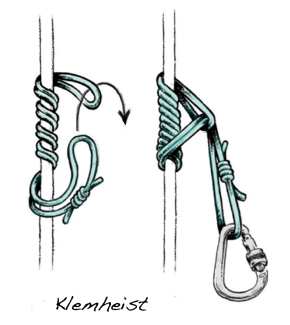
This is also the hitch to use for ascending thinner diameter poles. Just don’t forget – the klemheist is one directional so best to stick with the prusik hitch if working on horizontal safety or restraint lines.
Benefits:
- Fast to tie
- Can be tied with webbing or accessory cord
Learn to tie the klemheist hitch here.
 ROPE GUERRILLA